Cold Plunge in Redondo Beach: Benefits, What to Expect, and How to Start

What happens in your body during a cold plunge, the benefits with real research behind them, and how to build a routine that sticks.

Cold Plunge in Redondo Beach: Benefits, What to Expect, and How to Start

What happens in your body during a cold plunge, the benefits with real research behind them, and how to build a routine that sticks.

Cold plunge went from fringe to Tuesday-morning habit. Here is why the South Bay caught on first.

What the cold actually does, what your first session feels like, and how to make it a routine.
Three years ago, if you told someone on the Strand that you were voluntarily sitting in 50-degree water, they'd have looked at you like you were nuts. Now half the gym is talking about it.

Cold plunge therapy has gone from fringe biohacking to something your neighbor does on Tuesday mornings. And for good reason: the research behind cold water immersion is real, the benefits are hard to argue with, and once you get past the first 30 seconds, most people are surprised by how good they feel after.

We've been offering cold plunge at Club Elementum in Redondo Beach since 2024, and we've watched hundreds of people go from "absolutely not" to "I need this every week." Here's what we've learned, and what you should know if you're thinking about trying it.

What Actually Happens to Your Body in a Cold Plunge

Let's skip the buzzwords for a second. When you get into cold water (somewhere in the high 30s to low 50s), a few things happen pretty fast.

First, your blood vessels constrict. Blood pulls away from your extremities and toward your core and vital organs. Your heart rate spikes briefly, then settles. Your body dumps norepinephrine, a neurotransmitter that sharpens focus and lifts mood. This isn't some subtle thing. Norepinephrine levels can increase by 200-300% during cold exposure. That's a bigger spike than most people get from their morning coffee.

When you get out, your blood vessels dilate back open. Fresh, oxygen-rich blood rushes back into your muscles and joints. Inflammation drops. Muscle soreness decreases. And you feel genuinely alert, which is the part that's hard to explain until you've done it. Not jittery. Just clear.

That post-plunge clarity is what hooks most people. The physical recovery benefits are why they keep coming back.

The Benefits (Backed by Actual Research)

There's a lot of noise online about cold plunge. Some of it is overblown. Some of it is legit. Here's where the science is solid:

Recovery and inflammation

This is the most well-studied benefit. Cold water immersion reduces inflammatory markers and perceived muscle soreness after exercise. A 2022 meta-analysis across 52 studies found that cold water immersion significantly reduced delayed-onset muscle soreness (DOMS) compared to passive recovery. If you surf in the mornings, hit CrossFit, run the Esplanade, or just push hard at the gym, this matters.

Mood and mental health

That norepinephrine spike we mentioned? It's also linked to reduced symptoms of depression and anxiety. Cold exposure activates your sympathetic nervous system and triggers a dopamine release that can last for hours. A lot of our clients at Club Elementum say the mental benefits surprised them more than the physical ones. They came in for sore muscles and stayed for the headspace.

Immune function

Regular cold water immersion has been shown to increase white blood cell counts over time. A well-known Dutch study found that people who took cold showers for 30 days had a 29% reduction in sick days compared to the control group. Cold plunge takes that further.

Sleep

This one's a little more individual, but a lot of people who plunge in the afternoon or evening report sleeping noticeably better. The theory is that the rapid cooling and rewarming helps regulate your circadian rhythm. We've had clients in Redondo Beach and Hermosa Beach tell us it's the one thing that finally fixed their sleep after trying everything else.

Circulation

The constriction-dilation cycle is essentially a workout for your vascular system. Over time, this can improve circulation and cardiovascular efficiency. It's one reason cold plunge pairs so well with contrast therapy: alternating between our infrared sauna and the plunge amplifies this effect.

What Your First Session Looks Like

Here's the honest version, not the Instagram version.

You'll change, we'll walk you through the basics, and then you'll step into the plunge. The water is cold. Obviously. But the shock you're probably imagining (that panicky, gasping-for-air feeling) is mostly about breathing, and it's manageable.

The first 15-20 seconds are the hardest part. Your body wants to hyperventilate. Your job is to slow your breathing down. Breathe out long and slow through your mouth. That's the whole technique. Once you settle your breath, the cold turns tolerable. Not comfortable exactly, but manageable enough that some people start to enjoy it.

For your first time, we usually recommend 2-3 minutes. That's plenty. You don't need to sit in there for 10 minutes to get the benefits. Research shows most of the physiological response happens in the first 2-4 minutes.

When you get out, you'll feel a rush. Tingling skin, heightened alertness, maybe a little euphoria. Most first-timers say something like "I can't believe I just did that" followed by "when can I do it again?"

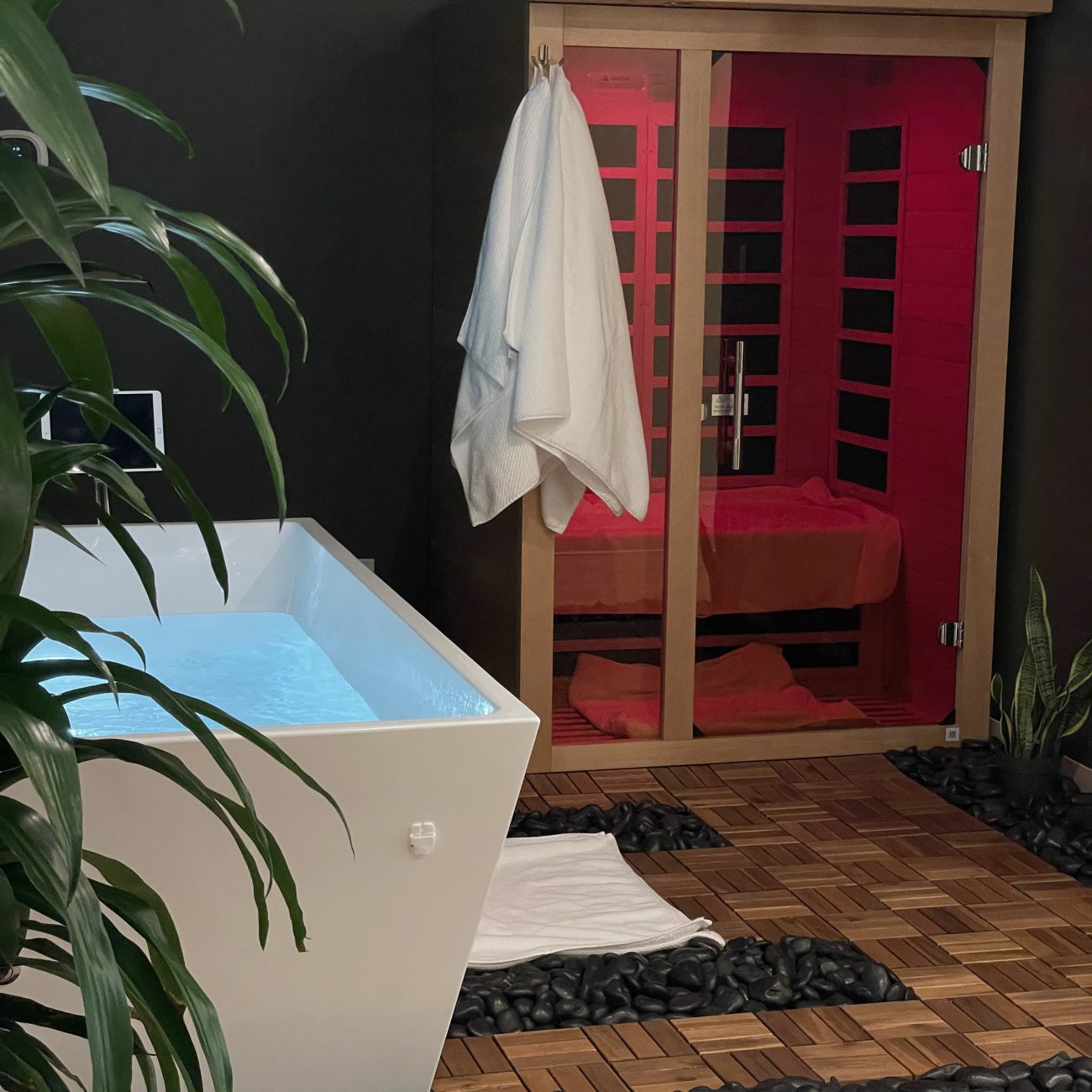
Our setup: we keep the water right around 50 degrees, and the plunge sits in its own private area rather than out on an open floor. It is just you, the water, and the timer. Want company? Bring someone you know and plunge together.

Who It's For (and Who Should Hold Off)

Cold plunge works for a surprisingly wide range of people. We see:

  • Athletes and surfers. This is the South Bay, so naturally a lot of our clients are active. Surfers dealing with shoulder fatigue, runners with shin and knee inflammation, lifters who are sore for days after leg day.

  • Desk workers. People who sit all day in Manhattan Beach or El Segundo office jobs and carry tension in their neck and shoulders. The cold resets something that stretching alone doesn't.

  • Stress and anxiety. The forced presence of cold water is a powerful pattern interrupt. You cannot think about your inbox at 50 degrees.

  • People who've tried everything. A lot of our regulars came in skeptical after months of foam rolling and ibuprofen didn't cut it.

Who should talk to a doctor first: If you have a heart condition, uncontrolled high blood pressure, Raynaud's disease, or you're pregnant, check with your physician before trying cold plunge. We take this seriously. It's a real conversation, not a waiver formality.

Cold Plunge + Other Therapies: The Recovery Stack

Cold plunge on its own is great. Combined with other modalities, it's a different level.

The protocol a lot of our clients follow at Club Elementum:

  1. Chiropractic adjustment first: get aligned, open up restricted joints

  2. Infrared sauna for 20-30 minutes: warm the muscles, increase blood flow, loosen everything up

  3. Cold plunge for 2-4 minutes: flush inflammation, constrict, reset

That sequence (align, heat, cold) is what's called contrast therapy, and it's one of the most effective recovery protocols we offer. The sauna opens your blood vessels, the cold plunge snaps them shut, and the cycling pushes waste products out of your tissue while pulling fresh blood in. It's like a deep-clean for your body.

You don't have to do all three every time. But if you've never tried the full stack, it's worth doing at least once. Most people who try it become regulars.

How to Build a Cold Plunge Routine

If you're new to this, don't try to become Wim Hof in week one. Here's a realistic progression:

Weeks 1-2: Once a week, 2 minutes. Focus entirely on your breathing. Don't worry about staying in longer.

Weeks 3-4: Once or twice a week, 2-3 minutes. You'll notice the initial shock getting less intense. Your body adapts fast.

Month 2+: Two to three times a week, 3-5 minutes. This is where most people settle into a sustainable routine that delivers consistent results.

You don't need to go every day. Some people do, and they're fine. But the research suggests 11 minutes of total cold exposure per week, spread across multiple sessions, is a solid target for ongoing benefits. That's three sessions of about 3-4 minutes each.

Why Redondo Beach (and the South Bay) Is Made for This

Look, there's a reason cold plunge is catching on here faster than almost anywhere else in LA. The South Bay is full of people who actually use their bodies: surfers at Torrance Beach, volleyball players in Hermosa, cyclists on the Marvin Braude path, CrossFit athletes in Torrance and El Segundo. Recovery isn't optional for these people. It's what lets them keep doing the things they love.

We built Club Elementum at 1312 Aviation Blvd in Redondo Beach because we wanted to be where the active people are. Cold plunge is one piece of what we offer, alongside chiropractic care, massage, infrared sauna, contrast therapy, and private Pilates. But for a lot of our clients, it's the piece that changed everything.

Ready to try cold plunge? Book your first session at Club Elementum in Redondo Beach. We'll walk you through everything, no experience needed. Questions? Call us at (310) 318-3143 or email hello@clubelementum.com.
Cold plunge went from fringe to Tuesday-morning habit. Here is why the South Bay caught on first.

What the cold actually does, what your first session feels like, and how to make it a routine.

Three years ago, if you told someone on the Strand that you were voluntarily sitting in 50-degree water, they'd have looked at you like you were nuts. Now half the gym is talking about it.

Cold plunge therapy has gone from fringe biohacking to something your neighbor does on Tuesday mornings. And for good reason: the research behind cold water immersion is real, the benefits are hard to argue with, and once you get past the first 30 seconds, most people are surprised by how good they feel after.

We've been offering cold plunge at Club Elementum in Redondo Beach since 2024, and we've watched hundreds of people go from "absolutely not" to "I need this every week." Here's what we've learned, and what you should know if you're thinking about trying it.

What Actually Happens to Your Body in a Cold Plunge

Let's skip the buzzwords for a second. When you get into cold water (somewhere in the high 30s to low 50s), a few things happen pretty fast.

First, your blood vessels constrict. Blood pulls away from your extremities and toward your core and vital organs. Your heart rate spikes briefly, then settles. Your body dumps norepinephrine, a neurotransmitter that sharpens focus and lifts mood. This isn't some subtle thing. Norepinephrine levels can increase by 200-300% during cold exposure. That's a bigger spike than most people get from their morning coffee.

When you get out, your blood vessels dilate back open. Fresh, oxygen-rich blood rushes back into your muscles and joints. Inflammation drops. Muscle soreness decreases. And you feel genuinely alert, which is the part that's hard to explain until you've done it. Not jittery. Just clear.

That post-plunge clarity is what hooks most people. The physical recovery benefits are why they keep coming back.

The Benefits (Backed by Actual Research)

There's a lot of noise online about cold plunge. Some of it is overblown. Some of it is legit. Here's where the science is solid:

Recovery and inflammation

This is the most well-studied benefit. Cold water immersion reduces inflammatory markers and perceived muscle soreness after exercise. A 2022 meta-analysis across 52 studies found that cold water immersion significantly reduced delayed-onset muscle soreness (DOMS) compared to passive recovery. If you surf in the mornings, hit CrossFit, run the Esplanade, or just push hard at the gym, this matters.

Mood and mental health

That norepinephrine spike we mentioned? It's also linked to reduced symptoms of depression and anxiety. Cold exposure activates your sympathetic nervous system and triggers a dopamine release that can last for hours. A lot of our clients at Club Elementum say the mental benefits surprised them more than the physical ones. They came in for sore muscles and stayed for the headspace.

Immune function

Regular cold water immersion has been shown to increase white blood cell counts over time. A well-known Dutch study found that people who took cold showers for 30 days had a 29% reduction in sick days compared to the control group. Cold plunge takes that further.

Sleep

This one's a little more individual, but a lot of people who plunge in the afternoon or evening report sleeping noticeably better. The theory is that the rapid cooling and rewarming helps regulate your circadian rhythm. We've had clients in Redondo Beach and Hermosa Beach tell us it's the one thing that finally fixed their sleep after trying everything else.

Circulation

The constriction-dilation cycle is essentially a workout for your vascular system. Over time, this can improve circulation and cardiovascular efficiency. It's one reason cold plunge pairs so well with contrast therapy: alternating between our infrared sauna and the plunge amplifies this effect.

What Your First Session Looks Like

Here's the honest version, not the Instagram version.

You'll change, we'll walk you through the basics, and then you'll step into the plunge. The water is cold. Obviously. But the shock you're probably imagining (that panicky, gasping-for-air feeling) is mostly about breathing, and it's manageable.

The first 15-20 seconds are the hardest part. Your body wants to hyperventilate. Your job is to slow your breathing down. Breathe out long and slow through your mouth. That's the whole technique. Once you settle your breath, the cold turns tolerable. Not comfortable exactly, but manageable enough that some people start to enjoy it.

For your first time, we usually recommend 2-3 minutes. That's plenty. You don't need to sit in there for 10 minutes to get the benefits. Research shows most of the physiological response happens in the first 2-4 minutes.

When you get out, you'll feel a rush. Tingling skin, heightened alertness, maybe a little euphoria. Most first-timers say something like "I can't believe I just did that" followed by "when can I do it again?"

Our setup: we keep the water right around 50 degrees, and the plunge sits in its own private area rather than out on an open floor. It is just you, the water, and the timer. Want company? Bring someone you know and plunge together.

Who It's For (and Who Should Hold Off)

Cold plunge works for a surprisingly wide range of people. We see:

  • Athletes and surfers. This is the South Bay, so naturally a lot of our clients are active. Surfers dealing with shoulder fatigue, runners with shin and knee inflammation, lifters who are sore for days after leg day.

  • Desk workers. People who sit all day in Manhattan Beach or El Segundo office jobs and carry tension in their neck and shoulders. The cold resets something that stretching alone doesn't.

  • Stress and anxiety. The forced presence of cold water is a powerful pattern interrupt. You cannot think about your inbox at 50 degrees.

  • People who've tried everything. A lot of our regulars came in skeptical after months of foam rolling and ibuprofen didn't cut it.

Who should talk to a doctor first: If you have a heart condition, uncontrolled high blood pressure, Raynaud's disease, or you're pregnant, check with your physician before trying cold plunge. We take this seriously. It's a real conversation, not a waiver formality.

Cold Plunge + Other Therapies: The Recovery Stack

Cold plunge on its own is great. Combined with other modalities, it's a different level.

The protocol a lot of our clients follow at Club Elementum:

  1. Chiropractic adjustment first: get aligned, open up restricted joints

  2. Infrared sauna for 20-30 minutes: warm the muscles, increase blood flow, loosen everything up

  3. Cold plunge for 2-4 minutes: flush inflammation, constrict, reset

That sequence (align, heat, cold) is what's called contrast therapy, and it's one of the most effective recovery protocols we offer. The sauna opens your blood vessels, the cold plunge snaps them shut, and the cycling pushes waste products out of your tissue while pulling fresh blood in. It's like a deep-clean for your body.

You don't have to do all three every time. But if you've never tried the full stack, it's worth doing at least once. Most people who try it become regulars.

How to Build a Cold Plunge Routine

If you're new to this, don't try to become Wim Hof in week one. Here's a realistic progression:

Weeks 1-2: Once a week, 2 minutes. Focus entirely on your breathing. Don't worry about staying in longer.

Weeks 3-4: Once or twice a week, 2-3 minutes. You'll notice the initial shock getting less intense. Your body adapts fast.

Month 2+: Two to three times a week, 3-5 minutes. This is where most people settle into a sustainable routine that delivers consistent results.

You don't need to go every day. Some people do, and they're fine. But the research suggests 11 minutes of total cold exposure per week, spread across multiple sessions, is a solid target for ongoing benefits. That's three sessions of about 3-4 minutes each.

Why Redondo Beach (and the South Bay) Is Made for This

Look, there's a reason cold plunge is catching on here faster than almost anywhere else in LA. The South Bay is full of people who actually use their bodies: surfers at Torrance Beach, volleyball players in Hermosa, cyclists on the Marvin Braude path, CrossFit athletes in Torrance and El Segundo. Recovery isn't optional for these people. It's what lets them keep doing the things they love.

We built Club Elementum at 1312 Aviation Blvd in Redondo Beach because we wanted to be where the active people are. Cold plunge is one piece of what we offer, alongside chiropractic care, massage, infrared sauna, contrast therapy, and private Pilates. But for a lot of our clients, it's the piece that changed everything.

Ready to try cold plunge? Book your first session at Club Elementum in Redondo Beach. We'll walk you through everything, no experience needed. Questions? Call us at (310) 318-3143 or email hello@clubelementum.com.

Start your wellness journey today

Our team is here to answer your questions and guide you toward the right care. Whether you are interested in chiropractic, recovery sessions, massage, or prenatal support, we will help you find the plan that fits your goals.

Profile portrait of a man in a white shirt against a light background

Dr. Riley Hunt, D.C.

Co-Founder, Chiropractor

Extreme close-up black and white photograph of a human eye

Contact us

Start your wellness journey today

Our team is here to answer your questions and guide you toward the right care. Whether you are interested in chiropractic, recovery sessions, massage, or prenatal support, we will help you find the plan that fits your goals.

Profile portrait of a man in a white shirt against a light background

Dr. Riley Hunt, D.C.

Co-Founder, Chiropractor

Extreme close-up black and white photograph of a human eye

Contact us

Start your wellness journey today

Our team is here to answer your questions and guide you toward the right care. Whether you are interested in chiropractic, recovery sessions, massage, or prenatal support, we will help you find the plan that fits your goals.

Profile portrait of a man in a white shirt against a light background

Dr. Riley Hunt, D.C.

Co-Founder, Chiropractor

Extreme close-up black and white photograph of a human eye

Contact us